
English| EUR
Suggested for you
More currencies
Choose a language
The Bali silver class in Uluwatu offers hands-on jewelry crafting in a working studio where visitors shape, solder, and polish their own sterling silver pieces. Each session runs two to three hours and requires no prior metalworking experience. This guide covers the workshop schedule, session structure, and practical details for planning your visit.
Quick answer
The bali silver class operates daily from 10:00 to 17:00 at Jl. Toya Ning II No.10 in Ungasan, with free studio entry and paid workshop sessions starting from 500,000 IDR. Each jewelry-making session takes two to three hours, so arrivals between 10:00 and 14:00 allow sufficient time to complete your piece before the studio closes. The workshop provides all tools, materials, and instruction.
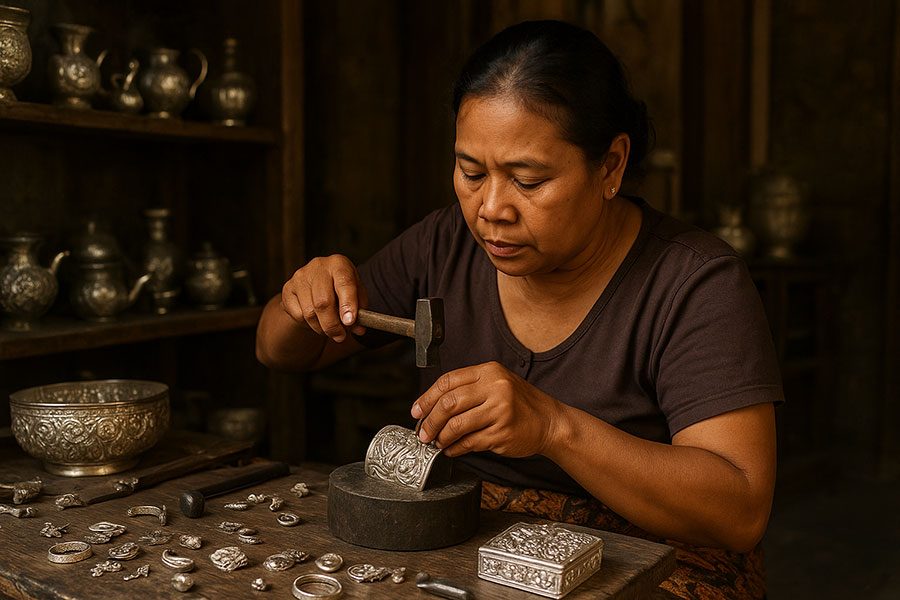
Every participant works with sterling silver stock—sheets, wire, and findings—sourced from local suppliers who serve Bali's artisan communities. The studio sits in Ungasan, a village three kilometers inland from the Uluwatu clifftop temple complex, where silversmiths have practiced traditional Balinese metalwork techniques for generations. Instructors demonstrate sawing, filing, soldering with a torch, and oxidizing finishes, then guide each visitor through the same steps at individual benches. Workshops accommodate different skill levels through adjustable project complexity. A simple band ring or pendant requires basic sawing and soldering. More intricate designs—granulation, repoussé, or multi-component assemblies—extend the session but follow the same process. The studio maintains an open layout so participants see other benches and ask questions across the room. This format mirrors how Balinese silversmiths traditionally learn, observing peers rather than following written instructions. The two-to-three-hour window accounts for metal cooling between soldering passes, polishing rounds, and the oxidation bath that darkens recessed details. Rushing these stages produces weak joints or uneven patina, so instructors set the pace. Most visitors leave with a wearable piece—a ring sized to their finger, a pendant on a leather cord, or a pair of earrings. The studio photographs finished work for participants who want documentation but prohibits videoing other attendees' faces or hands without consent. Uluwatu's silversmithing tradition stems from the same metallurgical knowledge that produced ceremonial kris daggers and temple ornaments across Java and Bali. Contemporary workshops translate those joining and finishing methods into accessible jewelry projects. The bali silver class maintains that lineage while adapting instruction for international visitors who lack the language or multi-year apprenticeships that traditional craft transmission requires. Participants handle the same tools—jeweler's saws, needle files, soldering picks—that professional silversmiths use in production studios across the island.
“Each workshop session follows the rhythm of metal cooling and polishing, pacing that cannot be rushed without compromising structural integrity.”
Bali Silver Class welcomes visitors throughout the week with consistent daily operating hours to accommodate workshop schedules.
There is no entrance fee to visit the facility. Costs are associated only with participation in silver jewelry workshops.
Verdict: A typical adult pays from 500000 IDR, depending on the specific jewelry design selected for the workshop.
To ensure sufficient time for the 2-3 hour jewelry crafting process, the best arrival window for visitors is 10:00–14:00. Arriving within this timeframe allows you to complete your session comfortably before the workshop closes.
—
Mid-week sessions typically offer a quieter environment for focused crafting.
—
Popular times often see more participants, so early arrival is recommended.
Dry and breezy (27°C)
These months provide consistent conditions for visiting the Uluwatu area.
Humid with rain (28°C)
Indoor workshops provide a reliable activity during periods of frequent rainfall.
Verdict: For the most consistent experience, arrive between 10:00 and 14:00 on a weekday during the dry season months of April or October.
The silver crafting workshop is located at Jl. Toya Ning II No.10 in the Ungasan area of Kuta Selatan. The most practical way to reach this location is by private vehicle, taxi, or ride-hailing service, as public transport options are limited in this part of the Bukit Peninsula.
Follow Jl. Raya Uluwatu toward Ungasan and turn onto Jl. Toya Ning II
Direct drop-off at Jl. Toya Ning II No.10
Walk from nearby Ungasan accommodation points
Use ride-hailing applications to navigate directly to the address, as local lanes in Ungasan can be narrow and complex. Ensure your driver follows the destination to Jl. Toya Ning II No.10 to arrive at the correct workshop entrance.
Prepare these items before your visit to ensure a smooth jewelry-making experience.
Everything you need to know about bali silver class
A bali silver class provides the necessary tools, raw materials, and expert guidance to help you craft your own unique piece of jewelry. You will learn foundational techniques such as soldering, filing, and polishing during your session.
There is no entry fee to visit the premises, as the facility offers free entry for guests. You only pay if you decide to participate in a scheduled workshop.
Paid jewelry workshops start from 500000 IDR per person. This fee generally covers the raw silver and the use of professional tools required for your creation.
Yes, these sessions are designed for all skill levels, including absolute beginners. The instructors provide step-by-step guidance to ensure you successfully complete your handcrafted accessory.
The jewelry crafting process typically takes between 2 to 3 hours to complete. We recommend allocating this time to ensure you can finish your project without rushing before closing.
Children are welcome to participate in the craft workshops with adult supervision. The experience is a popular activity for families looking to engage in creative traditions together.
The best arrival window is between 10:00 and 14:00. Arriving during this period ensures you have sufficient time to finish your silver project before the facility closes at 17:00.